
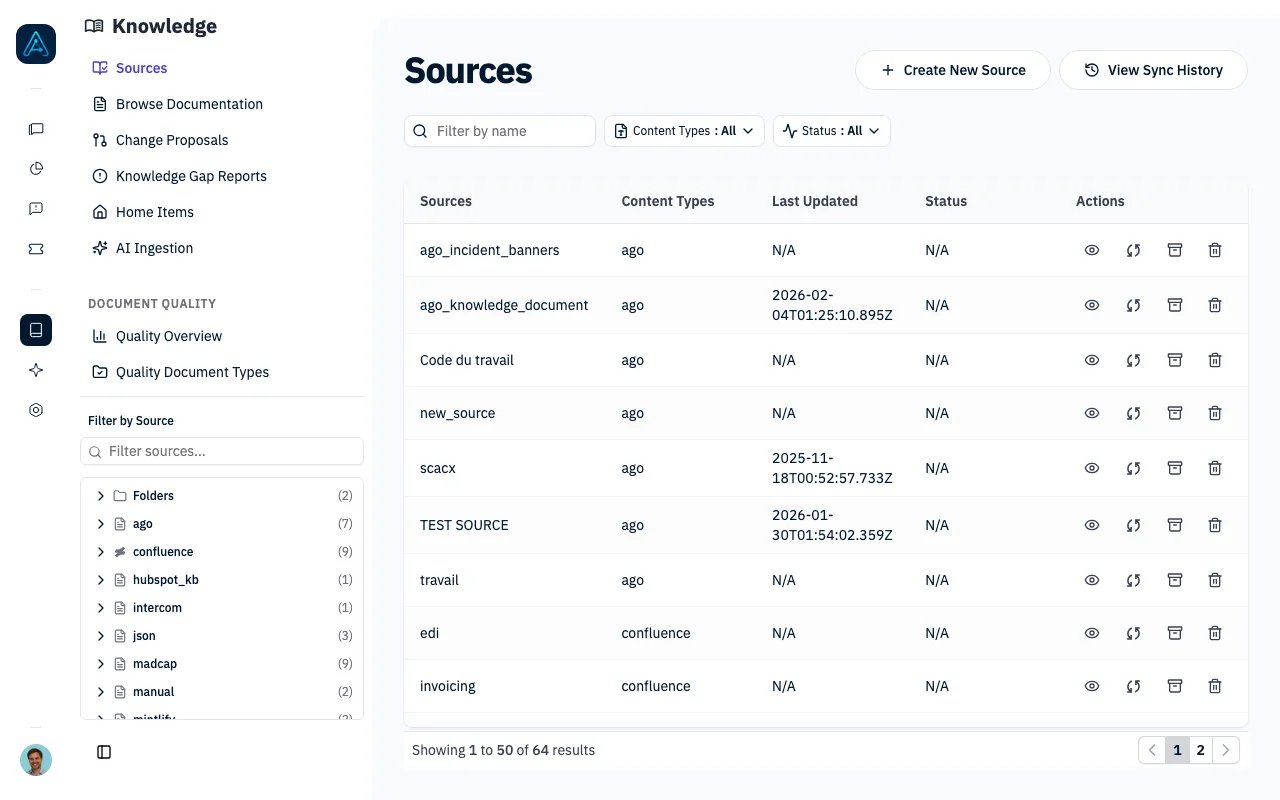
Knowledge Sources - Management
Overview
Knowledge sources are the foundation of your AI’s knowledge base. Each source connects to an external platform (like Notion, Confluence, or Zendesk) or contains manually created content, bringing documentation into AGO where it can be indexed and used by your AI agents. Key capabilities:- Connect to 14+ external documentation platforms
- Schedule automatic synchronization
- Monitor sync status and history
- Organize content with folder structures
- Control retrieval with restricted keywords
Features
Knowledge Source List
The Knowledge Sources page displays all available knowledge sources with information such as:- Source name
- Source type
- Owner (defaults to the person who created the source)
- Last modification date
- Last sync date
- Sync status
- Filter sources by name, type, and sync status
- Sort all sources by last modification date, newest or oldest first, by clicking the column heading
- Create new sources
- Edit existing sources
- Open a source’s actions menu and select Browse Documentation to view documents filtered by that source
- Trigger manual synchronization of sources
- Empty all documents from a source
- Delete sources entirely
Creating Knowledge Sources
The Create Knowledge Source page provides a form to create new sources with the following fields:- Name (required)
- Source Type (required)
- Source ID
- Domain
- Additional Info (JSON)
- API Key (encrypted)
- Owner
- Quality evaluation
- Restricted Keywords
Editing Knowledge Sources
The Edit Knowledge Source page allows administrators to modify existing sources. The form is pre-populated with the current values of the source. Open Advanced settings to manage the source’s owner, quality evaluation, and restricted keywords:- Owner: search for an administrator by name or email and select them, or select Unassigned to remove the owner. Only administrators can be selected. New sources default to their creator.
- Quality evaluation: select the document type used to evaluate the source, or choose no document type to clear it.
- Restricted keywords: control when the source’s documents are eligible for retrieval based on keywords in user messages.
Sync Status Knowledge Sources
The Knowledge Source Sync Status feature allows administrators to track and manage the synchronization status of knowledge sources through the admin interface. If a source has a wrong sync status, administrators can update it to reflect the current state which is probably no sync is happening and thus can select thereset option in the sync status dropdown.
Sync History and Timing
The sync history page lists every import run for your knowledge sources, with its status, the user who started it, and how long it took. For each finished import you can see the time spent in each phase of the run:- Import — fetching documents from the source
- Cleanup — removing old versions
- Links — resolving internal links (only for sources that support it, such as Confluence and Paligo)
- Embeddings — preparing documents for search
- Translation — translating documents into your active languages
Emptying Knowledge Sources
Administrators can empty all documents from a knowledge source without deleting the source itself. This is useful when:- You want to clear all imported documents before re-importing
- You need to remove outdated content while keeping the source configuration
- You want to start fresh with a source’s content
- Remove all knowledge documents associated with the source
- Preserve the source configuration and settings
- Show a confirmation dialog before proceeding
Downloading a Source for Analysis
Use the MCPexport_source tool or the source export API to download a ZIP of Markdown pages, subpage folders and stored attachments. Open index.html to browse the export, or give the extracted folder to a local AI assistant for text searches and analysis. manifest.json connects each file to its AGO document and update date.
Preparation runs in the background. Once ready, the ZIP is available for 24 hours, with a download link valid for up to four hours. You can renew the link and resume an interrupted download without generating the archive again.
Exports contain the current content, including AGO corrections. They are snapshots: editing extracted files does not update AGO. You can exclude attachments or use flat page paths. Requires the Knowledge Read permission (knowledge:read).
Auto-Sync Scheduling
Keep your knowledge base up-to-date automatically with scheduled synchronization. AGO checks for scheduled syncs every hour and processes them in the background.Schedule Types
Because schedules are checked once an hour, on the hour, a sync can start up to an hour after the time you set. A source scheduled for 13:30 runs at 14:00.
Configuring Auto-Sync
- Navigate to Knowledge → Sources
- Edit an existing source or create a new one
- Enable Auto-Sync
- Select a schedule type:
Schedule Configuration Fields
Timezone Handling
- Scheduled execution timestamps are stored in UTC; your chosen time of day uses the source timezone
- Configure your preferred timezone per source
- Next sync time is calculated in your timezone, then converted to UTC
- Common timezone examples:
UTC,America/New_York,Europe/Paris,Asia/Tokyo
Viewing Next Sync Time
Open a source’s detail page to see its next scheduled synchronization when automatic synchronization is enabled.Sync History and Monitoring
Track synchronization activity and diagnose issues with the sync history feature.Viewing Sync History
Open Knowledge → Sources, then click Sync History in the page header. Use the source filter to find a particular source’s runs.Sync History Fields
Live Import Progress (SharePoint)
While a SharePoint import is running, the row in sync history shows live stats so you can tell whether a long import is healthy or stuck:- Counter:
x/n doneplus failed and skipped counts - Current document: name of the file currently being extracted
- Last finished: how long ago the previous document completed
- Throughput: documents per minute
- ETA: estimated time left
Step Progress
While an import is running, the step it is on is highlighted and counts up the time it has spent there, so a step that has stopped making progress stands out from one that is simply slow. The embedding step reports its own counter. Documents are cut into chunks before being prepared for search, and the row shows how many are done (for example,150/420 chunks embedded) with its own progress bar. Until the chunks have been counted, the row reads Preparing chunks to embed….
If the embedding step cannot finish, the import is now marked Failed and the row says Crashed at: Embeddings with the reason. Previously such a run was reported as successful even though the new content had not reached search, so the only symptom was answers going stale. Editing a single document from the admin interface is unaffected: the document is still saved even if its embedding cannot be refreshed straight away.
Translation Progress
Every import finishes with a translation step. When your knowledge base has more than one active language, this step translates new and changed documents into the other languages, and the sync history row shows how many documents are left to translate (for example,6/10 documents remaining to translate). Only documents that actually need translation are counted: documents whose translations are already up to date and documents that link to an external page are skipped.
Cancelling a SharePoint Import
Running SharePoint imports can be stopped from the sync history row:- Click Cancel on the row
- Confirm in the dialog
Identifying Sync Types
- Manual sync from the admin interface: Shows the user who triggered it
- Automatic sync: User field is blank
- API-triggered sync: The user field may also be blank
Restricted Keywords
Control when documents from a source are eligible for retrieval during a conversation.How It Works
- Open Advanced settings and add keywords to Restricted Keywords.
- During retrieval, AGO checks user messages for matching source or document keywords.
- A restricted document is eligible when at least one keyword matches as a whole word, ignoring case.
billing and invoice make its documents eligible when user messages mention either word. Keywords do not remove documents during import.
Breadcrumb Navigation
Configure how navigation breadcrumbs appear in the knowledge portal.Enabling Breadcrumbs
- Edit your knowledge source
- Enable Breadcrumbs toggle
- Save the source
When to Use Breadcrumbs
Public Display
Control whether documents appear as source cards alongside conversation answers. In the source builder, this is the Show Documents in Chat setting.
The assistant is instructed not to cite, quote, link to, or reveal internal context. Disabling this setting on either a document or its source marks the document as internal.
This setting does not restrict access to documents in the knowledge portal or API.
Document Attachments
Add images and files to documents.Uploading Attachments
Via Admin Interface:- Open a document in the editor
- Click Upload image in the editor toolbar
- Select your image file
- The attachment is uploaded and can be referenced in content
Supported Formats
- Images: PNG, JPEG, GIF, WebP, SVG The editor’s upload button accepts images. For other attachment types, use the attachment API.
Referencing Attachments
Once uploaded, attachments can be referenced in document content using Markdown image syntax. The system automatically generates the correct URL when you insert an attachment through the editor.Table of Contents Management
Organize document ordering within sources.Reordering Documents
Via Admin Interface:- Navigate to Knowledge → select a source
- Use drag-and-drop to reorder documents
- Changes are saved automatically
Moving Documents
Move documents between parents in the hierarchy using drag-and-drop in the admin interface. For API access, see Public API v1 Reference.Best Practices
- Order by importance (most-used documents first)
- Group related documents together
- Keep getting-started content at the top
- Place troubleshooting at the end
Folder Sources (Included Sources)
Organize multiple knowledge sources into logical groups using folder sources.Creating a Folder Source
Folder sources group included sources for navigation. Their included-source relationships are configured through the source API; the source builder does not currently provide an Included Sources picker.Use Cases
- Group related documentation (e.g., all product documentation)
- Create department-specific knowledge sections
- Organize by content type (guides, FAQs, tutorials)
Troubleshooting
Sync Stuck in Progress
Sync Stuck in Progress
Symptom: Source shows “In Progress” for extended time.Solutions:
- Go to Knowledge → Sources
- Edit the affected source and open Sync Settings
- Select Reset in the sync status dropdown and click Save
- Trigger a new manual sync
Sync Fails Repeatedly
Sync Fails Repeatedly
Symptom: Sync completes with “Failed” status.Check:
- View sync history for error message
- Verify API credentials are valid and not expired
- Check external service is accessible
- Check that rate limits haven’t been exceeded
Documents Not Appearing
Documents Not Appearing
Symptom: Sync succeeds but documents are missing.Check:
- Verify the source ID/page ID is correct
- If documents exist but are not retrieved in conversations, check their restricted keywords
- Verify documents have content (empty pages may be skipped)
- For Notion: Verify the integration has access to the pages
OAuth Token Expired (Notion)
OAuth Token Expired (Notion)
Symptom: Notion sync fails with authentication error.Solution:
- Edit the source
- Use Connect with Notion to authorize the workspace again
- Complete the authorization flow and select the workspace and content
- Save and trigger sync
Configuration Reference
Knowledge sources have the following configurable settings: Core Settings:
Organization Settings:
Auto-Sync Settings:
Status:
Related
- Knowledge Connectors — Available connector types
- Knowledge Quality — Analyze imported content
- Knowledge Overview — Feature overview