Feedback Analysis
Accessing the Feedback List
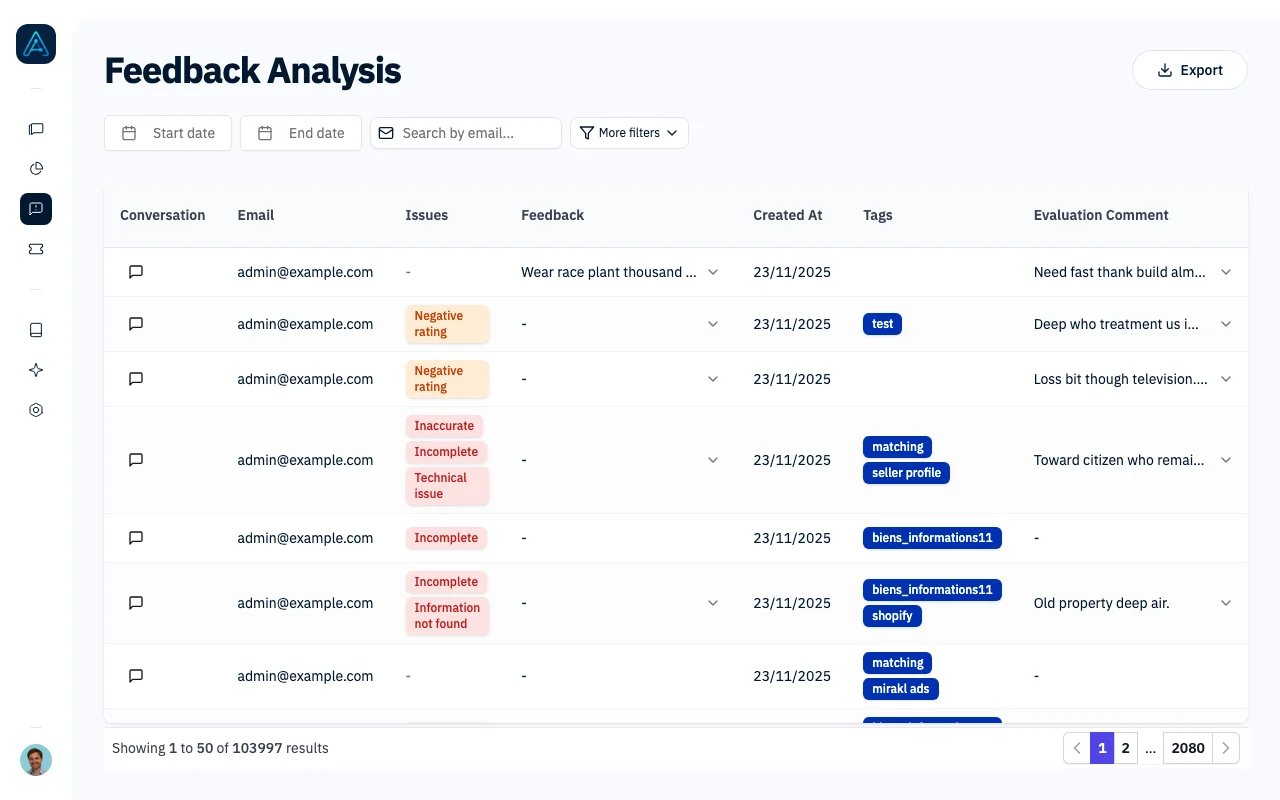
Navigate to Feedbacks in the sidebar.You need Admin or Account Manager permissions to access the Feedback page.
Feedback Table
The table displays feedback entries with the following columns:Issue Types
Feedback is categorized by issue type, shown as colored badges:
A single feedback entry can have multiple issue types.
Primary Filters
These filters are always visible:Secondary Filters
Click “More filters” for additional options:Inline Editing
You can edit certain fields directly from the list view without opening the conversation:Reviewer Assignment
Click the Reviewer dropdown in any row to assign or change the reviewer. Changes are saved automatically.Admin Status
Click the Admin Status dropdown to update the status. Available statuses are configured in your platform settings.Expanding Details
Click any row to expand and view:- Full additional feedback text
- Complete evaluation comments
Exporting Data
Click the Export button to download filtered feedback as a CSV file. The export includes all columns and respects your current filters. Exports of more than 1,000 entries are prepared in the background: a progress notification tracks the build, the download starts automatically when ready, and a bell notification lets you retrieve the file later if you navigate away. Background exports remain available for 24 hours.Quick Actions
View Conversation
Click the “Conversation” link to open the full conversation in the Conversation Management view.AI Debugger
Click the “AI Debugger” button to analyze why the agent responded the way it did, useful for investigating inaccurate responses.Create Task
When a feedback needs follow-up work, such as fixing a help article or reporting a bug, click Create task on its row to add it to your team’s Tasks board. The task opens with a generic title and the feedback linked as evidence; no customer text is copied into it. The form warns you when tasks already exist for this feedback. Available to staff users when Tasks is enabled for your workspace.Workflow Tips
Triaging New Feedback
- Filter by date range (e.g., last 24 hours)
- Review issue types to prioritize
- Assign reviewers for follow-up
- Set admin status to track progress
Investigating Inaccurate Responses
- Filter by Issue Type = “Inaccurate”
- Click conversation link to review
- Use AI Debugger to understand the response
- Update knowledge base if needed
- Set status to “Resolved”
Team Collaboration
- Assign feedback to team members via Reviewer field
- Use Admin Tags to categorize (e.g., “Knowledge Gap”, “Bug”)
- Set Admin Status to track progress (e.g., “In Progress”, “Fixed”)
Best Practices
- Review feedback daily: Address issues while they’re fresh
- Use status tracking: Keep admin status updated so team knows what’s been addressed
- Assign reviewers: Distribute workload and maintain accountability
- Tag for patterns: Use admin tags to identify recurring issues
- Close the loop: After fixing an issue, update status and add evaluation comment
Related Features
- Conversation Management - Review and evaluate conversations
- Feedback Analytics - Dashboard view of feedback trends
- AI Debugger - Investigate agent reasoning