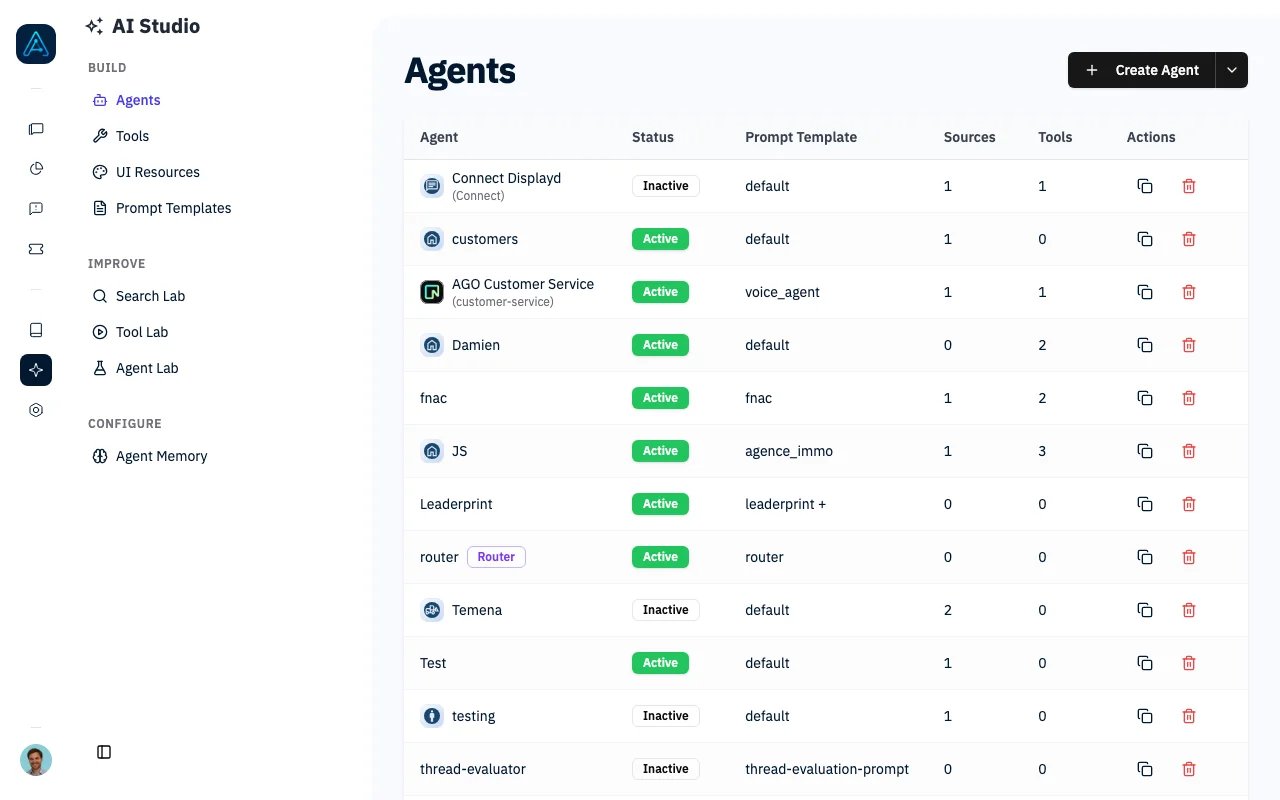
AI Studio - Agents List
Overview
Agents in AGO are intelligent assistants that can:- Answer questions using your knowledge base
- Execute actions using integrated tools
- Maintain context across conversation threads
- Handle background tasks for long-running operations
- Route requests to appropriate knowledge sources
- Invoke other agents for specialized tasks
- Collect user satisfaction feedback
- Use recent ticket history for personalized responses
Prerequisites
System Requirements
- AGO platform deployed and accessible
- Admin access to configure agents
Knowledge Required
- Understanding of AI/LLM concepts (temperature, tokens)
- Familiarity with your organization’s knowledge sources
Configuration Required
- LLM model configured in AGO Config
Editing Instructions in Fullscreen
In the agent’s General tab, open Instructions and click Enter fullscreen next to the prompt editor. The editor expands to fill the screen, and the change comparison, revert, and version history controls remain available. Click Exit fullscreen, close the window, or press Escape to return to the agent settings. Your edits stay in the form and are saved to the agent’s draft. Click Publish on the agent page to apply them to the live agent.Drafts and Testing
Changes to an existing agent are saved automatically to the agent’s draft a moment after you make them. The live agent your users talk to does not change until you click Publish. The header shows whether the draft is saved. There is one draft per agent, shared by every administrator: anyone who opens the agent sees the same draft, with who edited it last and when. If someone else changes the draft while you are editing, a message asks you to reload to see their version.- View changes lists every setting the draft changes, grouped by tab: the live value and the draft value, the sources, tools or permissions added and removed, and a line-by-line comparison of the instructions. Click Undo on a change to set it back to the live value.
- Publish is available once the draft differs from the live agent. It first shows the changes to confirm, then applies the settings you changed in the draft to the live agent. Other settings changed on the live agent in the meantime, such as the agents’ order, are kept. If someone changed the same setting on the live agent, AGO asks you to confirm before replacing it.
- Discard draft deletes the draft for everyone and shows the live agent again. If you undo your edits by hand, the draft disappears on its own.
- History next to the instructions loads an earlier version of the instructions into the draft. Shared prompt templates change only when you publish.
- If a source, tool or other selected item is deleted, it is removed from the draft and a message tells you.
Testing the draft
Test agent beside Publish opens a conversation beside the editor. Write a message at the bottom and press Enter or click the send arrow to try the draft. Use Shift+Enter for a new line. Ask follow-up questions in the same conversation, or click New conversation to start over. If you change a setting, the conversation continues with the new version and a Configuration changed line marks where it changed. Click Retry under the last answer to ask the same question again with the current settings, as if the previous answer had never been given. Open Documents used under an answer to see which knowledge documents the agent received for it, or read No documents used when it answered without any. The information button explains which settings the test uses. On smaller screens, the back arrow returns to the editor. Tests use the whole draft: instructions, model, knowledge sources, pinned documents, retrieval settings, tools, subagents, MCP servers, toolkits and API context sources. Tests run as your administrator account; they do not impersonate an end user to check access rules. Test activity may be retained for debugging, but it does not update the agent’s memory. Testing supports existing standard text agents; create the agent first. Router, background and voice agents are not supported in this panel. You can also edit, test and publish drafts through the Public API and the MCP server.Agent Types
AGO supports three types of agents, each optimized for different use cases.Standard Agents
Real-time conversational agents that provide immediate responses by:- Retrieving relevant documents from knowledge base
- Generating contextual responses
- Streaming responses to users via SSE (Server-Sent Events)
- Using tools when necessary
Background Agents
Long-running agents for complex tasks that:- Process requests asynchronously in the background
- Provide progress updates during execution
- Handle multi-step workflows
- Execute time-consuming operations
Results and Progress
When a run ends, its conversation shows a report and an outcome:
The checklist shows the current plan and each step’s reported progress. At the end, the agent’s final checklist replaces the live plan and may revise its steps. A 100% checklist does not by itself confirm the objective was achieved; use the outcome and final report together. Unfinished or failed steps include an explanation when the run ends. The report and checklist remain available when you reopen the conversation. Older runs without a recorded outcome show Execution ended — outcome unavailable.
Limits, rejected approvals, or errors can leave partial results. AGO does not automatically start another run to finish that work. A new message starts a new task with its own checklist; approving or resuming a paused run continues that existing task. Before requesting another attempt, read what already happened so you do not repeat an action.
Completion reflects the agent’s report and available execution information; it is not an independent audit of changes in external systems.
Action Approvals
A tool can be marked Require approval in background runs in its builder (see Tools). When a background agent is about to use such a tool — issuing a refund, for example — the run pauses and an approval card appears in the conversation:- Staff users see which tool the agent wants to use and the exact values it wants to send, with Approve and Reject buttons. Staff members also receive a bell notification.
- Other viewers see that the run is waiting for a decision, without the tool’s data.
- Approve lets the agent execute the action and continue. Reject skips the action; the agent is told it was not approved and concludes accordingly.
- A pending approval expires after 72 hours. The run is then stopped and the conversation shows that the approval expired.
Interrupted Runs
Background runs save their progress as they go. If a run is interrupted — during a deployment, for example — it is not lost: a card appears in the conversation asking a staff member whether to resume the run from its last completed step or stop it. Resuming may re-run the step that was in flight when the interruption happened, which is why a person confirms it rather than the system resuming silently.Reasoning Agents
Extended reasoning capabilities for complex problem-solving:- Multiple reasoning iterations for thorough analysis
- Uses dedicated reasoning model from global config
- Ideal for complex logic and multi-step reasoning
ℹ️ NOTE: Reasoning agents use the dedicated reasoning model configured in your AGO backend settings, separate from the default LLM.Best for: Complex problem solving, analysis requiring multiple reasoning steps, decision-making tasks
Router Agents
Router agents transparently route each user message to the most appropriate specialized agent. The routing is invisible to the user — they see responses as if they were speaking directly to the selected specialist. Best for: Multi-agent orchestration, request triage, routing users to domain-specific specialistsℹ️ NOTE: An agent cannot be both a router agent and a reasoning agent at the same time.See the Router Agent page for full configuration details, routing logic, and best practices.
Agent Documentation Sections
Agent APIs
Learn how to programmatically send messages to agents and integrate AGO into your applications. Topics Covered:- Send message API endpoint
- Request/response formats
- File attachment handling
- Server-Sent Events (SSE) streaming
- Background agent processing
- Error handling and fallback mechanisms
- Custom chat interfaces
- Mobile app integration
- Workflow automation
- Chatbot embedding
Agent Configuration
Configure how agents behave and who can access them:Agent Permissions
Control which users and groups can access specific agents. Topics Covered:- Permission-based agent selection
- User group assignments
- Role-based access control
- Default agent configuration
Agents Homepage Selection
Configure which agents appear on the homepage for different user groups. Topics Covered:- Homepage agent display
- Priority ordering
- User-specific agent recommendations
- Custom agent selection logic
Agent Capabilities
Knowledge Base Integration
Agents can access and search through:- Imported documentation (Notion, Confluence, Paligo, Zendesk, etc.)
- Knowledge articles created directly in AGO
- Pinned documents that are always included in context, or only when the conversation mentions a keyword
- Documents to retrieve: How many documents to fetch for context (default: 8)
- Documents to display: How many to show users in sources (default: 8)
- Pinned documents: Documents always included in agent context
Pinned documents with trigger keywords
In the agent’s Context tab, open Pinned Documents and type keywords under a selected document, then press Enter. You can type or paste a list separated by commas, semicolons or line breaks:invoice, VAT, refund adds three keywords. That document is then included only once a user message in the conversation contains one of its keywords:
- A keyword matches as a whole word, ignoring case:
invoicematches “Where is my Invoice?” but not “invoices”. - Every user message in the conversation counts, so the document stays included for follow-up questions.
- A pinned document without keywords is always included.
Tool Usage
Agents can execute tools to:- Create support tickets
- Query external APIs
- Perform calculations
- Retrieve real-time data
- Execute custom workflows
- Send emails
- Invoke other agents
Agent-as-Tool
Agents can invoke other agents as tools, enabling:- Specialization: Create focused agents for specific domains
- Delegation: Route complex queries to specialized agents
- Composition: Build complex workflows from simple agents
⚠️ WARNING: Set the max call depth appropriately to prevent infinite recursion when agents invoke each other.
Context Management
Agents maintain context by:- Tracking conversation history
- Remembering user preferences
- Linking related threads
- Preserving file attachments
Multi-language Support
Agents support multiple languages through:- Automatic language detection
- Translated knowledge base content
- Localized responses
- Multi-language document retrieval
Satisfaction Feedback
Collect user feedback after agent responses:
Negative feedback actions:
ticket_form: Show ticket creation formfeedback_form: Show detailed feedback formmessage_only: Display a message
satisfaction_feedback_response_type):
yes_no(default): Two buttons — Yes / Nosmiley_3: Three smiley faces — happy, neutral, unhappy
Ticket Context Injection
Give your agent awareness of the user’s recent support tickets. When enabled, the agent’s system prompt automatically includes a summary of the user’s ticket history, allowing it to provide more personalized and context-aware responses. How it works: When preparing a response, AGO retrieves the user’s recent tickets and adds a summary to the agent’s context. The agent sees each ticket’s status, subject, last update date, and a link. Closed tickets are excluded. With Zendesk connected, AGO refreshes the user’s linked tickets directly from Zendesk. For users signed in through a supported authentication method with a verified customer identity, AGO also looks up their recent Zendesk tickets, including tickets created outside AGO. Descriptions, replies, and private notes are not included. See Zendesk Ticket Context for supported authentication methods. Zendesk results are cached for up to one minute. Newly created tickets can take longer to appear in Zendesk search. If Zendesk is unavailable, the agent can still use stored ticket details, with a note that they may be out of date. Example context injected:
Configuration tips:
- Time limit: Set the days limit to control how far back tickets are included. Use
7for recent context or select No time limit to include older tickets - Performance: A maximum of 10 tickets are included, ordered by most recent first
- Ticketing system required: The user must have tickets in a connected ticketing system for context to appear
ℹ️ NOTE: Anonymous visitors can receive refreshed Zendesk details for tickets already associated with their AGO visitor identity, including older tickets. An email entered in a form does not give access to other tickets for that email. Returning visitors need the same anonymous identity; using another browser does not automatically restore their ticket history.
Configuration Options
Basic Settings
LLM Settings
ℹ️ NOTE:
- Temperature: Lower values (0.0-0.3) produce consistent, deterministic responses. Higher values (0.7-1.0) allow more creative variation.
- Top P: Controls diversity by limiting token selection to the most probable tokens whose cumulative probability exceeds this threshold.
- Some models ignore these: models of the GPT-5 family and OpenAI’s o-series set their own creativity levels and accept no override; Azure deployments carry their own settings; Amazon Bedrock models take Temperature but not Top P. A setting the selected model ignores is greyed out, with a note saying so. The value you saved is kept and applies again if you switch the agent to a model that accepts it.
Knowledge Settings
Tool Settings
Background/Reasoning Settings
Global Agent Settings
These settings in AGO Config affect all agents system-wide. Individual agents can override some of these settings.System-Wide Configuration
Default Ticketing Tool Description
Configuring Global Settings
These settings are configured at the system level via the Config API. See the Public API v1 Reference for details on how to update these settings programmatically.Override Behavior
Troubleshooting
Agent returns "I don't know" for documented topics
Agent returns "I don't know" for documented topics
Problem: Agent can’t find relevant documents despite content existing in knowledge base.Solutions:
- Verify the knowledge source is assigned to the agent
- Increase the “Documents to Retrieve” setting to fetch more context
- Review document chunking - documents may be split poorly
- Check if content is in the correct language
Agent responses are too creative/inconsistent
Agent responses are too creative/inconsistent
Problem: Responses vary significantly for the same question.Solutions:
- Lower the Temperature setting (try 0.1–0.3)
- Lower the Top P setting (try 0.5–0.7)
- Add pinned documents with authoritative answers
Background agent never completes
Background agent never completes
Problem: Background agent tasks stay in “processing” state.Solutions:
- Check background processing logs for errors
- Verify the task hasn’t exceeded timeout limits
- Monitor progress via
/message/{id}/progress-streamendpoint - Check if external tool calls are hanging
Agent-as-tool invocation fails
Agent-as-tool invocation fails
Problem: Agent can’t invoke another agent as a tool.Solutions:
- Verify the target agent has “Enable as Tool” turned on
- Check the invoking agent has the target in its Agent Tools list
- Ensure the max call depth hasn’t been exceeded
- Review the tool description for clarity
Satisfaction feedback not appearing
Satisfaction feedback not appearing
Problem: Feedback buttons don’t show after responses.Solutions:
- Verify “Enable Satisfaction Feedback” is turned on for the agent
- Check that the feedback question is not empty
- Ensure widget version supports feedback
API Reference
For programmatic access to agents, see:- Public API v1 Reference - Agent management and messaging
Related
- Router Agent — Automatic message routing to specialist agents
- Prompt Templates — Create and manage prompt templates
- Agent Memory — Configure conversation memory
- Tools — Add capabilities to your agents
- Agent Permissions — Control agent access
- Simulation Testing — Test agent behavior
- Agent Best Practices — Design patterns and tips
- Build Your First Agent — Step-by-step tutorial