> ## Documentation Index
> Fetch the complete documentation index at: https://ago.mintlify.site/llms.txt
> Use this file to discover all available pages before exploring further.
# Conversation Labels
> Create and manage topics, admin tags, and custom statuses used to organize and categorize conversations
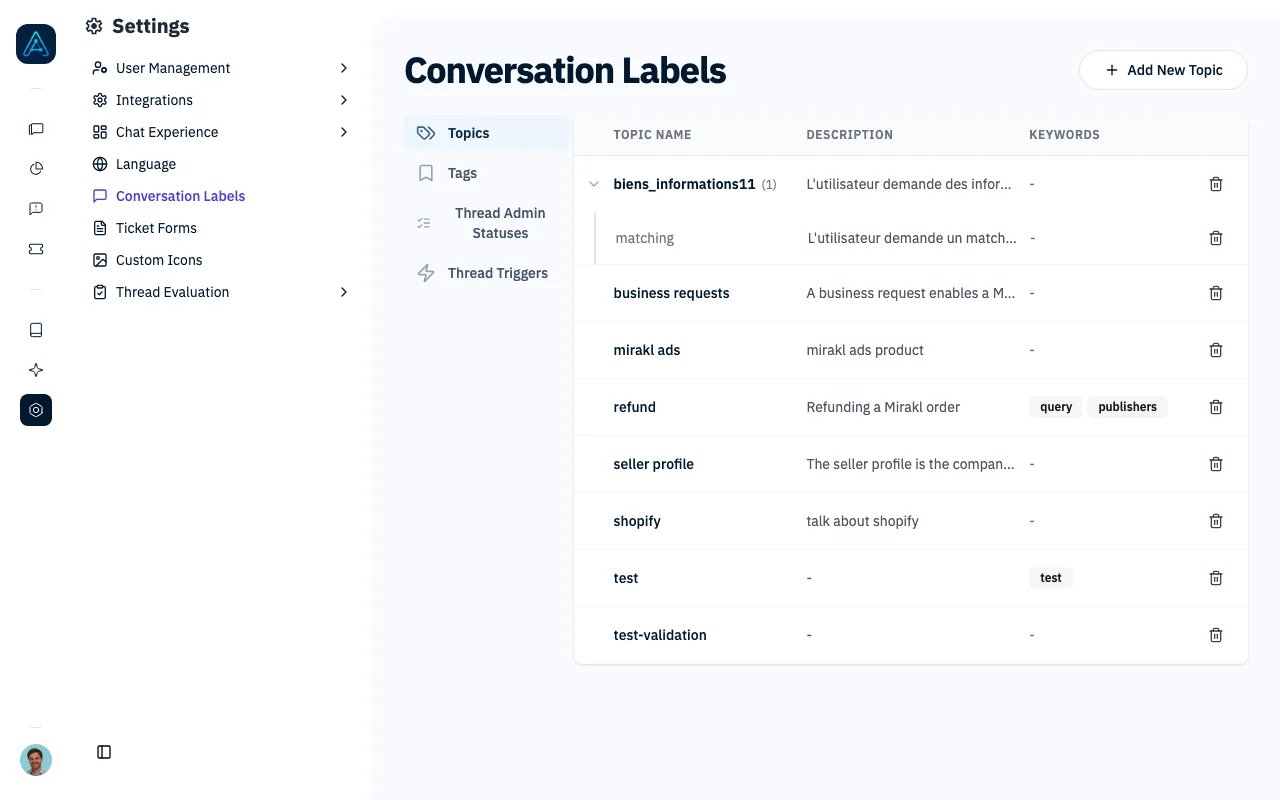 The Conversation Labels page is where you create and manage the topics, admin tags, and admin statuses that organize your conversations. Topics defined here are used by the [Topic Analyzer](/features/thread-tagger) for automatic categorization and feed into the [Topics Analytics](/features/topics-analytics) dashboard.
## Accessing Conversation Labels
Navigate to **Settings** in the sidebar, then select **Conversation Labels**.
You need Admin permissions to manage conversation labels.
## Topics Tab
Topics are labels that categorize conversations by subject. The Topic Analyzer assigns them automatically, and you can also apply them manually from the conversation sidebar.
### Creating a Topic
1. Click **Add Topic**
2. Fill in the fields:
| Field | Description | Required |
| ---------------- | -------------------------------------------------------------------------------------------- | -------- |
| **Name** | Topic label displayed in the UI and analytics | Yes |
| **Description** | Explains what this topic covers — the AI uses this when deciding whether to assign the topic | No |
| **Keywords** | Words or phrases that trigger keyword-based matching (case-insensitive, whole-word) | No |
| **Parent Topic** | Select an existing topic to create a hierarchy | No |
3. Click **Save**
### Hierarchical Topics
Topics support parent/child relationships. For example:
* **Support** (parent)
* **Billing Support** (child)
* **Technical Support** (child)
* **Sales** (parent)
* **Upsell** (child)
* **New Lead** (child)
Child topics inherit their parent's context. In the [Topics Analytics](/features/topics-analytics) treemap, you can click a parent topic to drill down into its children.
### Editing and Deleting Topics
* Click a topic row to edit its name, description, keywords, or parent
* Click the delete button to remove a topic
Deleting a topic removes it from future analysis but does not remove the tag from conversations that were already tagged with it.
## Admin Tags Tab
Admin tags are internal labels visible only to staff members. They help you categorize conversations for team workflows — for example, "Knowledge Gap", "Bug Report", or "VIP Customer".
### Creating an Admin Tag
1. Click **Add Tag**
2. Enter the tag name and optional description
3. Optionally assign a color for the badge
4. Click **Save**
Admin tags can be applied to conversations from the [Conversation Management](/features/conversation-management) sidebar and used as filters in [Chat History](/features/conversations-list).
## Admin Status Tab
Admin statuses are custom status labels for conversations — for example, "Under Investigation", "Escalated", or "Resolved". They help you track conversation progress through your workflow.
### Creating an Admin Status
1. Click **Add Status**
2. Enter the status name and optional description
3. Optionally assign a color
4. Click **Save**
Admin statuses can be set from the conversation sidebar and used as filters in Chat History and the Feedback page.
## How Topics Connect to Other Features
| Feature | How It Uses Topics |
| ------------------------------------------------------------ | ------------------------------------------------------------------------------------- |
| [Topic Analyzer](/features/thread-tagger) | Automatically assigns topics to conversations based on keywords and AI classification |
| [Topics Analytics](/features/topics-analytics) | Shows topic distribution, trends, CX Score by topic, and escalation rates |
| [Conversations](/features/conversations-list) | Filter conversations by topic in Chat History |
| [Conversation Management](/features/conversation-management) | View and manually edit topics in the conversation sidebar |
## Best Practices
1. **Start with 10-20 topics** — too many dilutes the analysis; too few misses important patterns
2. **Use descriptive names** — "billing-support" is clearer than "category-3" for both humans and the AI
3. **Add keywords for predictable terms** — if users always mention "invoice" for billing topics, add it as a keyword for fast matching
4. **Use hierarchy for structure** — group related topics under a parent to keep the Topics Analytics treemap readable
5. **Review quarterly** — merge low-volume topics, split high-volume ones that cover too many subjects
## Related Features
* [Topic Analyzer](/features/thread-tagger) - Configure automatic topic assignment
* [Topics Analytics](/features/topics-analytics) - View topic distribution and trends
* [Conversation Management](/features/conversation-management) - Apply topics to individual conversations
* [Conversations](/features/conversations-list) - Filter conversations by topic
The Conversation Labels page is where you create and manage the topics, admin tags, and admin statuses that organize your conversations. Topics defined here are used by the [Topic Analyzer](/features/thread-tagger) for automatic categorization and feed into the [Topics Analytics](/features/topics-analytics) dashboard.
## Accessing Conversation Labels
Navigate to **Settings** in the sidebar, then select **Conversation Labels**.
You need Admin permissions to manage conversation labels.
## Topics Tab
Topics are labels that categorize conversations by subject. The Topic Analyzer assigns them automatically, and you can also apply them manually from the conversation sidebar.
### Creating a Topic
1. Click **Add Topic**
2. Fill in the fields:
| Field | Description | Required |
| ---------------- | -------------------------------------------------------------------------------------------- | -------- |
| **Name** | Topic label displayed in the UI and analytics | Yes |
| **Description** | Explains what this topic covers — the AI uses this when deciding whether to assign the topic | No |
| **Keywords** | Words or phrases that trigger keyword-based matching (case-insensitive, whole-word) | No |
| **Parent Topic** | Select an existing topic to create a hierarchy | No |
3. Click **Save**
### Hierarchical Topics
Topics support parent/child relationships. For example:
* **Support** (parent)
* **Billing Support** (child)
* **Technical Support** (child)
* **Sales** (parent)
* **Upsell** (child)
* **New Lead** (child)
Child topics inherit their parent's context. In the [Topics Analytics](/features/topics-analytics) treemap, you can click a parent topic to drill down into its children.
### Editing and Deleting Topics
* Click a topic row to edit its name, description, keywords, or parent
* Click the delete button to remove a topic
Deleting a topic removes it from future analysis but does not remove the tag from conversations that were already tagged with it.
## Admin Tags Tab
Admin tags are internal labels visible only to staff members. They help you categorize conversations for team workflows — for example, "Knowledge Gap", "Bug Report", or "VIP Customer".
### Creating an Admin Tag
1. Click **Add Tag**
2. Enter the tag name and optional description
3. Optionally assign a color for the badge
4. Click **Save**
Admin tags can be applied to conversations from the [Conversation Management](/features/conversation-management) sidebar and used as filters in [Chat History](/features/conversations-list).
## Admin Status Tab
Admin statuses are custom status labels for conversations — for example, "Under Investigation", "Escalated", or "Resolved". They help you track conversation progress through your workflow.
### Creating an Admin Status
1. Click **Add Status**
2. Enter the status name and optional description
3. Optionally assign a color
4. Click **Save**
Admin statuses can be set from the conversation sidebar and used as filters in Chat History and the Feedback page.
## How Topics Connect to Other Features
| Feature | How It Uses Topics |
| ------------------------------------------------------------ | ------------------------------------------------------------------------------------- |
| [Topic Analyzer](/features/thread-tagger) | Automatically assigns topics to conversations based on keywords and AI classification |
| [Topics Analytics](/features/topics-analytics) | Shows topic distribution, trends, CX Score by topic, and escalation rates |
| [Conversations](/features/conversations-list) | Filter conversations by topic in Chat History |
| [Conversation Management](/features/conversation-management) | View and manually edit topics in the conversation sidebar |
## Best Practices
1. **Start with 10-20 topics** — too many dilutes the analysis; too few misses important patterns
2. **Use descriptive names** — "billing-support" is clearer than "category-3" for both humans and the AI
3. **Add keywords for predictable terms** — if users always mention "invoice" for billing topics, add it as a keyword for fast matching
4. **Use hierarchy for structure** — group related topics under a parent to keep the Topics Analytics treemap readable
5. **Review quarterly** — merge low-volume topics, split high-volume ones that cover too many subjects
## Related Features
* [Topic Analyzer](/features/thread-tagger) - Configure automatic topic assignment
* [Topics Analytics](/features/topics-analytics) - View topic distribution and trends
* [Conversation Management](/features/conversation-management) - Apply topics to individual conversations
* [Conversations](/features/conversations-list) - Filter conversations by topic